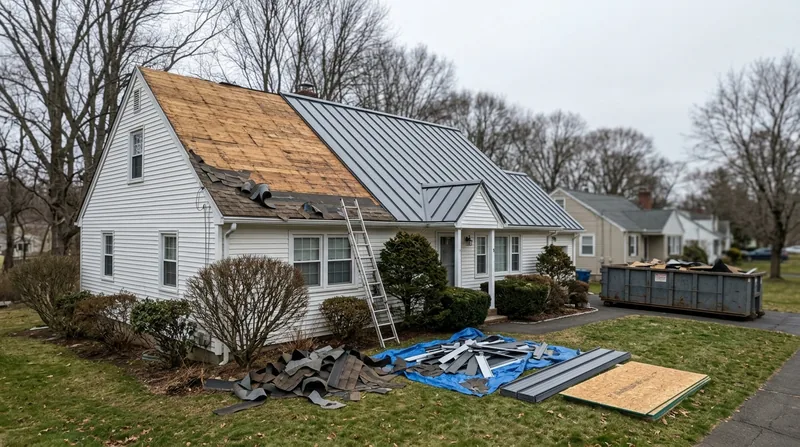




Metal Roof Replacement in New Haven
New Haven roofs take a beating that most of the country never sees: nor'easters driving rain sideways off Long Island Sound, ice dams forming at the eaves of 1920s Colonials in East Rock, and wet snow loading the low-pitch triple-deckers of Fair Haven. When your shingles or old metal panels reach the end of the line, Metal Roof Replacement in New Haven means a full tear-off, honest decking work, and a new metal system built for this climate. We work the traprock ridges and shoreline blocks from Westville to Morris Cove, and we know what fails first on each house type. If your roof is still serviceable, we tell you and point you to metal roof repair instead. When replacement is the right call, we build it to last through freeze-thaw cycles, salt air, and falling limbs from the maples and oaks that shade these streets.
Why Metal Roof Replacement Matters on New Haven's Housing Stock
The dominant failure mode in New Haven is not heat or hail. It is winter ice and freeze-thaw. Snow sits on a low-slope roof, melts at the warm edge, refreezes at the eave, and backs water up under the shingles. On the 1860s-1900s Victorians and Italianates in Wooster Square and Edgewood, that water finds old skip sheathing and rafter tails. On the 1940s-60s Cape Cods and brick ranches across West Haven and East Haven, it rots the bottom two courses of decking before anyone notices a stain on the ceiling.
- Metal sheds snow and ice far better than asphalt, which cuts ice-dam risk at the eaves.
- A full tear-off lets us inspect decking and rafter condition that a layover would hide.
- Salt air off the Sound attacks cut edges and fasteners, so we specify coastal-grade panels and screws.
- Older homes in historic districts may need design review before you pick a panel profile or color.
- Falling limbs from mature maples and tulip poplars are a real cause of panel dents and seam damage.
Replacing at the right time costs less than patching a failing roof through three winters.
Key info: A 1920s Dutch Colonial in Beaver Hills with two ice-dam seasons behind it usually needs new eave decking, not just new shingles. We price the decking repair into the replacement so there are no surprises once the old roof is off.
Roofing permits are commonly required for a full replacement in New Haven, and thresholds and inspection requirements vary by jurisdiction. Check with the City of New Haven building department before work starts, and confirm any historic district review that applies to your block.
How We Tear Off and Rebuild a Metal Roof in New Haven
Every replacement follows the same sequence, whether it is a shoreline cottage in Woodmont or a large colonial in Orange. We protect the landscaping, strip the old roof to the deck, fix what the tear-off exposes, then install the new metal system with ice-and-water shield at the eaves and valleys. The order matters because ice damage and hidden rot are what drive callbacks.
- We walk the roof with you and document the existing condition for insurance and permitting.
- We pull the permit and schedule the tear-off around weather windows.
- We remove the old roofing and haul it away the same day.
- We inspect and repair decking, rafters, and fascia before anything goes back down.
- We install ice-and-water protection at eaves and valleys, then underlayment across the field.
- We set the new panels or shingles, flash chimneys and skylights, and finish the trim.
- We clean the site, walk the roof with you, and hand over the paperwork.
If your existing roof is a single layer of shingles in good shape, a metal roof over shingles may save you the tear-off cost, and we will tell you honestly when that path is code-legal and when it is not.
Key info: On a 1950s split-level in North Haven, the tear-off exposed rotted decking at the valley where a previous repair had trapped water. We replaced the sheathing, added ice-and-water shield, and the new standing seam roof has stayed dry through two nor'easters.
Replacement Approaches We Install in New Haven
The right system depends on your roof pitch, your budget, and whether the house sits in a historic district. These are the approaches we install most often on New Haven-area homes.
| Approach | Description | Best for |
|---|---|---|
| Standing seam | Concealed fasteners, raised seams, long panel runs with clean lines. | Colonials and large homes in East Rock, Orange, and Branford. |
| Exposed fastener panels | Corrugated or ribbed panels screwed through the face, economical and fast to install. | Barns, additions, and budget-conscious replacements in West Haven and East Haven. |
| Metal shingles | Stamped panels that mimic slate or cedar, with a period-appropriate look. | Victorian and Italianate homes where historic review applies. |
| Stone-coated steel | Granulated steel shingles that look like asphalt or shake but shed ice better. | Cape Cods and ranches in Hamden, North Haven, and Wallingford. |
| Copper and specialty metal | Soldered or seamed copper for landmarks, churches, and premium homes. | Historic churches and older landmarks around the Green. |
We match the system to the house, not the other way around. A standing seam roof on a low-pitch triple-decker and a stone-coated steel roof on a Madison colonial are different jobs with different details.
Metal Roof Replacement Cost in New Haven: What to Expect
Pricing starts at From $9/sq ft for a basic exposed-fastener replacement and climbs from there. The big variables are pitch, tear-off layers, decking condition, and whether the panels can be staged close to the house. A steep Victorian in Wooster Square with limited street access costs more to do safely than a ranch in Wallingford with a wide driveway.
- Roof size and pitch drive the square-foot count and the labor hours.
- The number of existing layers affects tear-off time and disposal cost.
- Rotted decking or rafter repairs add material and labor once exposed.
- Panel type, gauge, and finish move the material cost up or down.
- Access, staging, and proximity to trees or power lines affect the crew plan.
Get two or three written estimates and compare scope, not just the bottom line. Our full pricing overview breaks down what each tier includes.
Metal Roof Replacement Near Me: How to Vet a Contractor in New Haven
When you search for a metal roofing contractor near me, the first filter is paperwork. Then ask for local references on homes like yours, not a generic list.
- Confirm the contractor is licensed and insured in Connecticut and can show a certificate.
- Get at least two or three estimates with itemized scope and material specs.
- Ask for references from New Haven-area jobs done in the last two years.
- Confirm who pulls the permit and whether historic district review applies to your block.
- Check HOA rules for panel profile and color before you order material.
Good contractors welcome the questions. If you are ready to talk through your roof, contact us for a free estimate.
Metal Roof Replacement in New Haven: Pricing Guide
| Service | Price | Details |
|---|---|---|
| Exposed fastener replacement | Starting at $9/sq ft | Includes tear-off, decking inspection, underlayment, and new ribbed panels with fasteners. |
| Standing seam replacement | Starting at $14/sq ft | Concealed fasteners, raised seams, and full flashing; pitch and panel gauge move the price. |
| Stone-coated steel or metal shingle | Starting at $12/sq ft | Includes tear-off, underlayment, and stamped panels; historic district details add labor. |
| Complex or large-scale job | On estimate | Steep pitches, multiple tear-off layers, decking rot, or tight access need an on-site look first. |
| Travel | Included | In New Haven and surrounding areas, with no separate call-out or mileage fee. |
| Estimate | Free | Response within 24 hours at (475) 234-4843, with no obligation to book. |
Indicative pricing, the exact cost depends on square footage, finish, and site access. Free personalized estimate within 24h at (475) 234-4843.


